

Introduction
Non-probability sampling plays an important role in research when it is not feasible, practical, or necessary to select participants using statistical probability. Unlike probability sampling, where every unit has a known and equal chance of selection, non-probability sampling relies on the judgment, convenience, or accessibility of participants. Although it does not allow for generalisation to the entire population with statistical precision, it remains widely used in social sciences, business studies, psychology, health research, and exploratory investigations where depth, context, and speed are more important than representativeness.
When Sampling Frames are not Available?
One of the major reasons researchers adopt non-probability sampling is the non-availability of a sampling frame. A sampling frame refers to a complete and accurate list of all units in the population. In many real-world studies, such lists simply do not exist. For example, there is no comprehensive list of informal workers, gig economy participants, trauma survivors, or social media micro-influencers. Without such a frame, it becomes impossible to apply probability sampling methods, which require a clear population listing. In these situations, researchers rely on non-probability techniques such as convenience, purposive, or snowball sampling to reach relevant participants. These methods help overcome access limitations and enable data collection even when the population is dispersed, hidden, or unregistered.
Why Non-Probability Sampling still works when Sampling Principles are followed
Even though non-probability sampling does not involve strict random selection, it can still produce meaningful and credible findings when core sampling principles, adequacy, randomness, and representativeness, are consciously applied during the selection process. Adequacy ensures that the sample size is sufficiently large to capture variations in attitudes or behaviours; randomness, even if partial, helps minimise selection bias by diversifying the avenues through which participants are approached; and representativeness is enhanced when researchers make deliberate efforts to include individuals from different demographic, social, or professional segments relevant to the study. When these principles are embedded thoughtfully, non-probability samples often yield insights that are both practically useful and contextually rich.
Relevance to countries like India
This becomes particularly important in countries like India, where formal or updated sampling frames, with complete lists of potential respondents and their contact details, are uncommon or entirely unavailable for many study populations. Informal workers, gig economy participants, micro-entrepreneurs, community volunteers, neighbourhood associations, or social media–based groups do not exist in any structured registry. As a result, researchers often rely on non-probability methods not by choice but by necessity. When adequacy, randomness, and representativeness are applied wherever possible, non-probability sampling becomes a strong and practical alternative, enabling researchers in India to generate reliable and socially meaningful evidence despite structural limitations in population listings.
Major Non-Probability Sampling used in Research
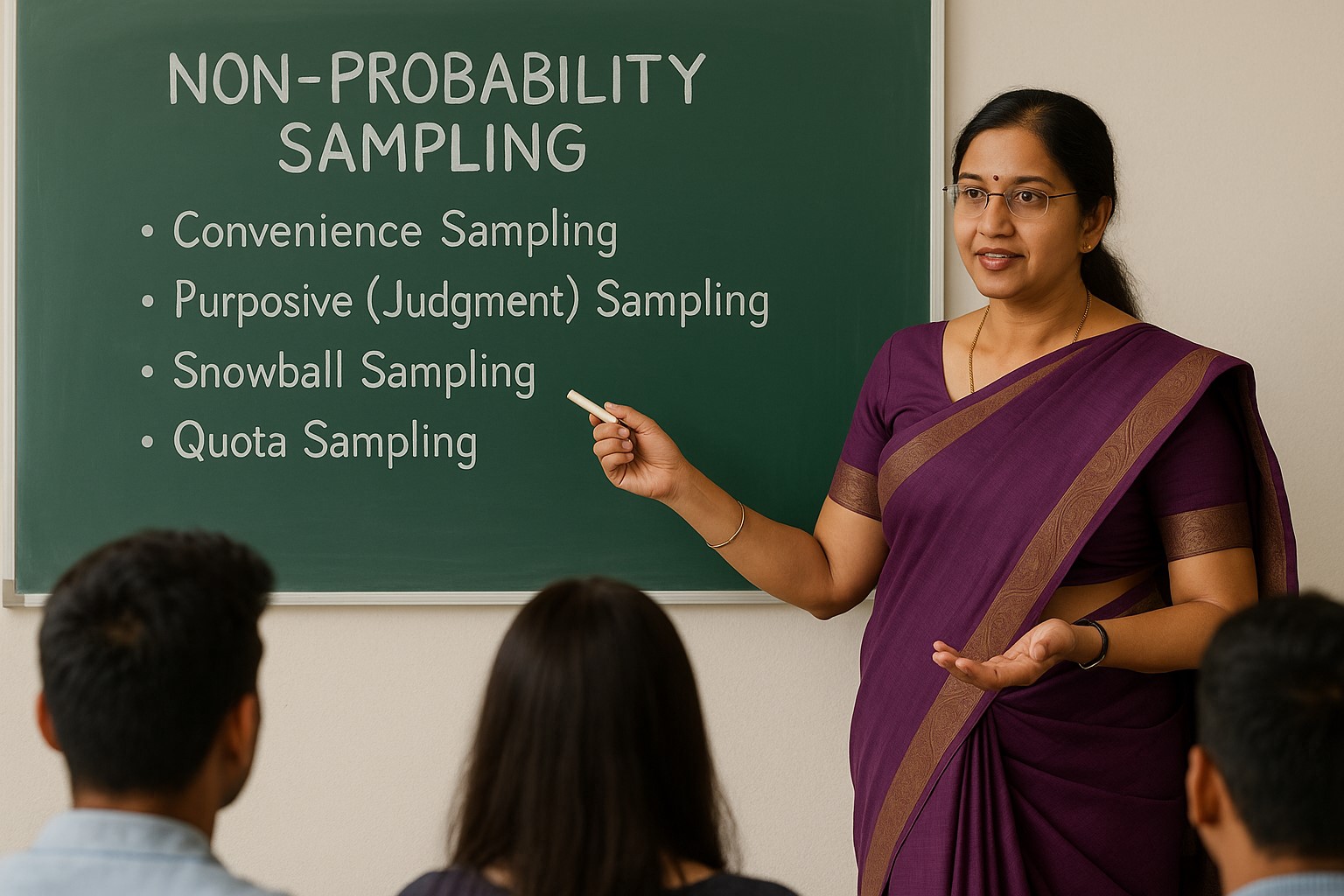
1. Convenience Sampling
Convenience sampling involves selecting respondents who are easily accessible to the researcher. It is often chosen when time, cost, or access limitations make random sampling difficult.
Practical Examples
Education Research: A researcher studying student stress levels may distribute surveys only to the students present in a particular classroom.
Healthcare Studies: A physiotherapy clinic collecting feedback from patients visiting during a particular week.
Marketing Research: A mall kiosk interviewing walk-in customers to understand preferences for a new product.
2. Purposive (Judgment) Sampling
Purposive sampling involves choosing participants based on specific characteristics or relevance to the study’s purpose. The researcher intentionally selects individuals who can provide meaningful insights.
Practical Examples
Social Sciences: Selecting only single mothers from low-income households for a coping strategy study.
Business Research: Interviewing start-up founders to study leadership behaviour.
Environmental Studies: Sampling fishermen from highly vulnerable coastal zones affected by erosion.
3. Snowball Sampling
Snowball sampling is used when the target population is hard to locate or comprises hidden groups. Participants refer additional respondents, helping the sample grow in a chain-like manner.
Practical Examples
Health Research: Identifying individuals with rare diseases.
Psychology/Sociology: Recruiting people recovering from addiction or trauma.
Criminology: Studies involving cybercrime participants or underground networks.
4. Quota Sampling
Quota sampling requires dividing the population into subgroups and selecting a predetermined number of participants from each group, though selection is still non-random.
Practical Examples
Market Research: Setting quotas for male and female respondents for a smartphone preference survey.
Urban Studies: Selecting fixed numbers of metro, bus, and auto-rickshaw commuters.
HR Research: Studying work-life balance across freelancers, part-time workers, and full-time employees.
5. Self-Selection Sampling
Self-selection sampling allows individuals to volunteer to participate in the research.
Practical Examples
Online Research: Respondents filling out voluntary Google Forms or social media polls.
Medical Studies: Participants registering for wellness programs or clinical screenings.
Media Research: Readers or viewers joining feedback panels.
6. Expert Sampling
Expert sampling involves selecting individuals who possess specialised knowledge or experience relevant to the research.
Practical Examples
Technology Research: Interviewing AI developers or cybersecurity experts.
Policy Studies: Consulting urban planners, economists, or government advisors.
Medical Research: Collecting insights from experienced surgeons or senior consultants.
Advantages of Non-Probability Sampling
- Useful for exploratory and descriptive research.
- Ideal when sampling frames are unavailable.
- Cost-effective and quick.
- Helps reach specialised or hidden populations.
- Enables deeper qualitative insights.
- Offers flexibility in dynamic research environments.
Limitations
- Cannot statistically generalise findings to the wider population.
- Prone to selection bias.
- May lack representativeness.
- Researcher judgment can influence sample composition.
Conclusion
Non-probability sampling remains a practical and valuable approach across multiple research domains. Whether studying consumer behaviour in marketing, understanding vulnerable populations in public health, or exploring emerging social trends, these sampling methods offer accessibility, depth, and flexibility. When sampling frames are incomplete or unavailable, an increasingly common challenge in modern research, non-probability sampling becomes not just a choice but a necessity. While it may not support broad generalisation like probability methods, it provides meaningful insights that help researchers understand complex human behaviours, contexts, and experiences.






Leave a Reply