

Introduction
Research aims to generate reliable and valid knowledge by examining cause-and-effect relationships. Whether the study belongs to medicine, education, psychology, business, or social sciences, researchers often need to determine whether a specific factor genuinely influences an outcome. To achieve this, control groups and experimental groups play a central role in research design. These groups help researchers separate the real impact of an intervention from changes that may occur naturally or due to external influences.
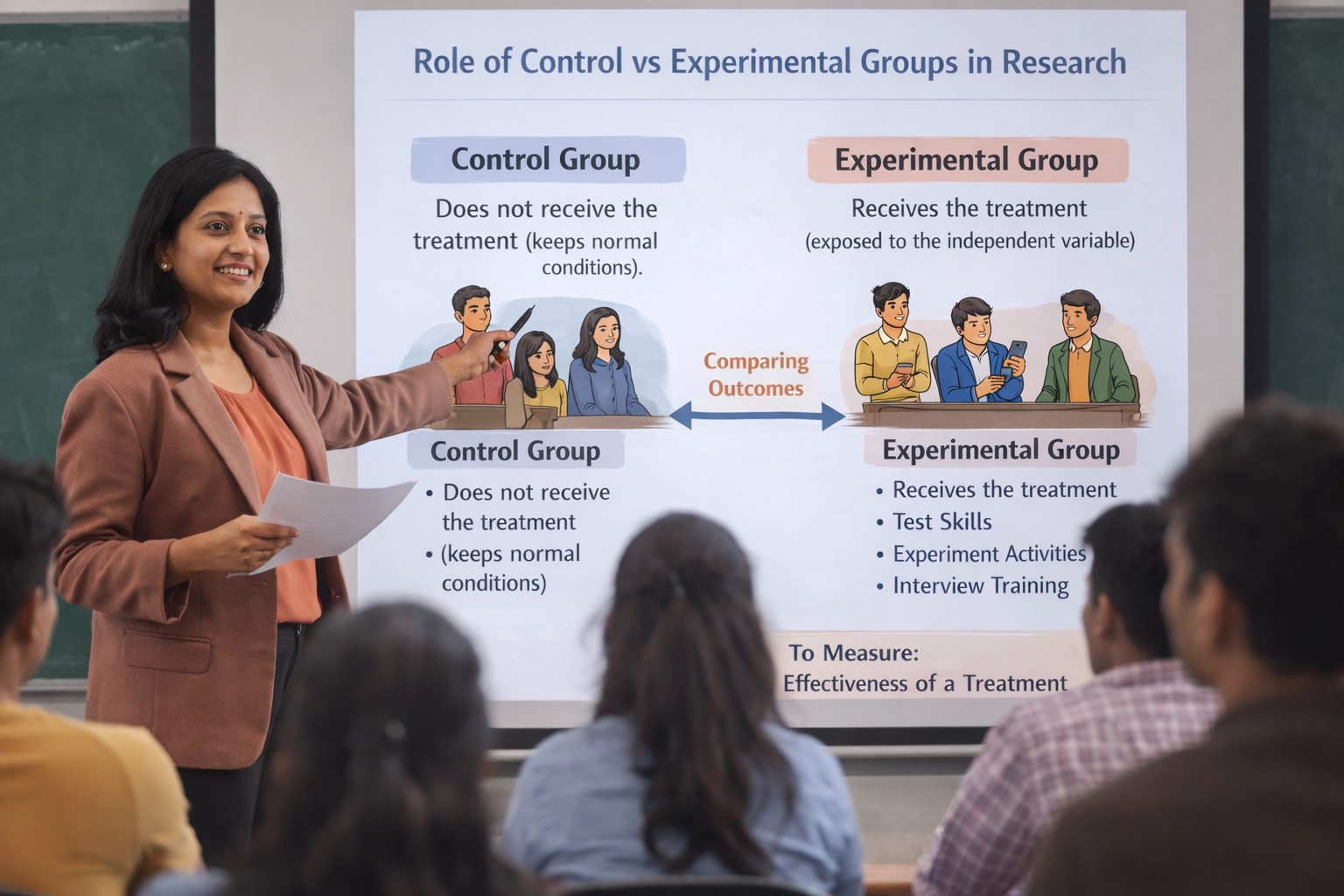
In simple terms, the experimental group receives the treatment or intervention being tested, while the control group does not. Comparing outcomes between these two groups allows researchers to draw meaningful conclusions about the effectiveness, usefulness, or impact of the variable under study. Without this comparison, research findings may remain speculative and unreliable.
Understanding Control and Experimental Group
A control group acts as a benchmark. Participants in this group experience normal conditions and are not exposed to the experimental treatment. This group helps researchers understand what would happen in the absence of the intervention.
An experimental group, on the other hand, is exposed to the independent variable or treatment. Any difference observed between the control and experimental groups is attributed to this intervention, provided other conditions are kept constant.
For example, if a researcher wants to test whether a new teaching method improves student performance, one group of students is taught using the new method (experimental group), while another group continues with the traditional method (control group). Differences in performance can then be reasonably linked to the teaching approach.
Control groups help eliminate bias, confusion, and false conclusions. In real-world settings, outcomes may change due to time, environment, motivation, or personal differences. The control group ensures that such natural variations are not mistakenly interpreted as effects of the treatment.
Without a control group:
- Researchers cannot confidently claim causation.
- Results may be influenced by placebo effects or external factors.
- Findings become weak and difficult to replicate.
Thus, control groups strengthen internal validity, ensuring that observed changes are genuinely due to the intervention.
Control vs Experimental Groups (Social Science Example)
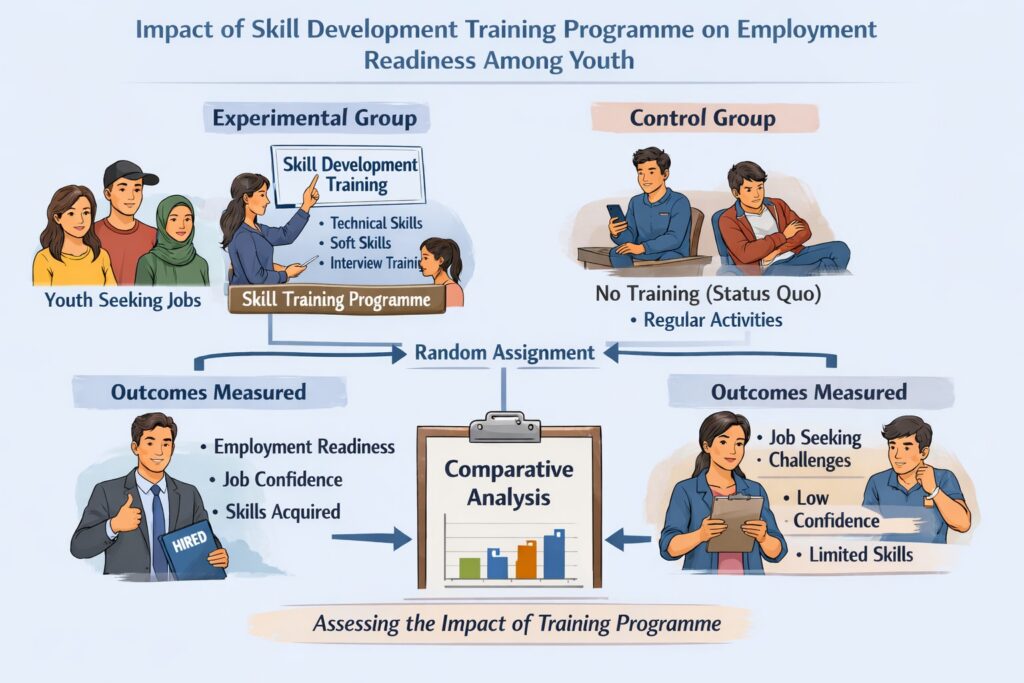
Study Focus: Impact of a Skill Development Training Programme on Employment Readiness among Youth
Population: Youth participants from similar socio-economic backgrounds
Random Assignment: Participants are randomly divided into two groups
Experimental Group
- Receives Skill Development Training
- Exposed to the intervention(independent variable)
Outcome measured: Employment readiness, confidence, skill acquisition
Control Group
- Does not receive training
- Continues with normal conditions
Outcome measured using the same indicators
Comparison
- Differences in outcomes between the two groups are analysed
- Any significant improvement in the experimental group is attributed to the training programme
The following Image explains the above example:
Examples from different domains of study
1. Medical and Health Sciences
In clinical trials, control and experimental groups are critical for ensuring patient safety and treatment effectiveness. For instance, when testing a new drug for diabetes, patients in the experimental group receive the new medication, while those in the control group receive existing treatment or a placebo.
If the experimental group shows better health outcomes with fewer side effects, researchers can confidently attribute improvements to the new drug. This comparison protects patients from ineffective or harmful treatments and supports evidence-based medicine.
2. Education and Learning Research
In education, researchers often examine whether new teaching strategies improve learning outcomes. Suppose a school introduces digital learning modules. One group of students uses these modules (experimental group), while another continues with textbook-based learning (control group).
By comparing exam scores, engagement levels, and retention rates, educators can determine whether digital learning genuinely enhances academic performance or merely appears attractive without real benefits.
3. Psychology and Behavioural Studies
Psychological research frequently relies on control and experimental groups to study behavior, emotions, and mental processes. For example, a stress-management intervention may be tested on working professionals.
Participants in the experimental group receive counselling or mindfulness training, while the control group receives no intervention. Changes in stress levels, emotional regulation, or job satisfaction are compared to assess the intervention’s effectiveness.
4. Business and Management Research
In business studies, control and experimental groups are widely used in marketing, HR, and organisational research. For instance, a company may introduce flexible working hours for one department (experimental group) while another department continues traditional schedules (control group).
Comparing productivity, absenteeism, and job satisfaction helps management decide whether the policy should be expanded across the organisation.
5. Social Sciences and Public Policy
Governments and NGOs use control and experimental groups to evaluate social programs. For example, a skill development program may be implemented in one community while another similar community does not receive the program.
Differences in employment rates, income levels, or social mobility help policymakers assess whether the initiative truly improves livelihoods or requires redesign.
Ethical Considerations
While control and experimental groups are essential, ethical responsibility is equally important. Researchers must ensure informed consent, fairness, and participant welfare. In some cases, withholding treatment from a control group may raise ethical concerns, especially in medical or social welfare studies. Researchers often address this by providing delayed treatment or alternative benefits.
Challenges in Using Control and Experimental Groups
Despite their importance, researchers face practical challenges:
- Difficulty in random assignment
- Participant dropout
- External influences affecting results
- Ethical and logistical constraints
Careful planning, pilot testing, and transparent reporting help overcome these challenges and strengthen research credibility.
Conclusion
Control and experimental groups form the backbone of scientific research. Together, they allow researchers to move beyond assumptions and establish clear cause-and-effect relationships. Across domains such as medicine, education, psychology, business, and public policy, these groups ensure that findings are accurate, meaningful, and applicable to real-world problems.
By maintaining a clear distinction between what is tested and what serves as a baseline, researchers contribute to evidence-based knowledge that informs decision-making, policy formulation, and professional practice. Understanding the role of control and experimental groups is therefore essential for anyone engaged in research or consuming research-based information.






Leave a Reply