

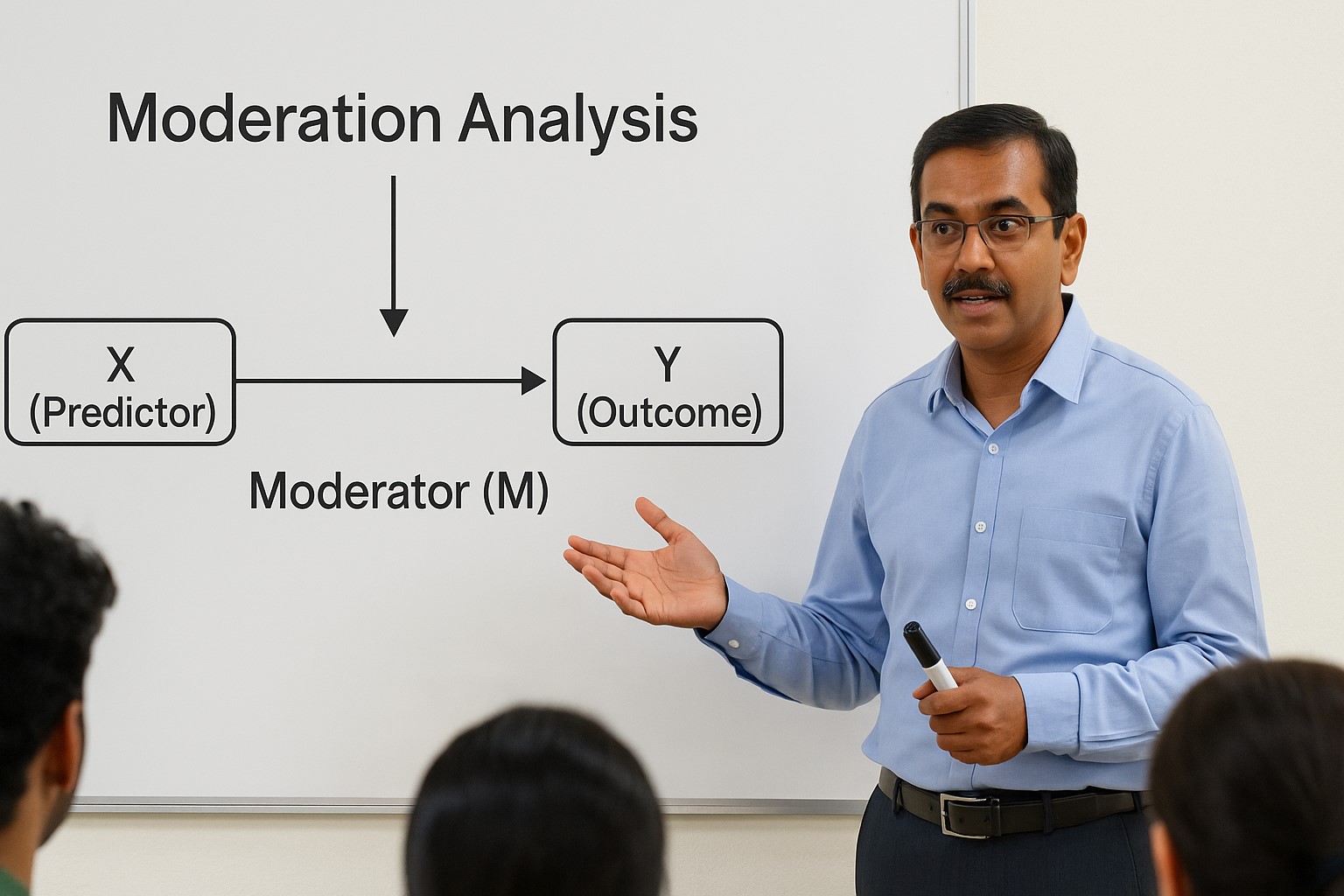
In many research settings, relationships between variables do not operate uniformly across all individuals or situations. A factor that significantly influences an outcome in one context may have a different impact when conditions change. Moderation analysis is a statistical approach that helps researchers identify and understand these conditional effects. In simple terms, moderation explains when, for whom, or under what circumstances a predictor variable influences an outcome. This ability to clarify conditional relationships makes moderation an essential analytical tool across psychology, business, education, health sciences, and the social sciences.
Moderation occurs when a third variable modifies the direction or strength of a relationship between an independent variable and a dependent variable. Instead of assuming that the effect is constant, moderation allows researchers to explore how different levels of a moderating variable alter the primary relationship. For example, the association between work stress and job performance might depend on an employee’s level of emotional intelligence. High emotional intelligence could buffer the negative effects of stress, whereas low emotional intelligence may intensify performance decline.
What is Moderation?
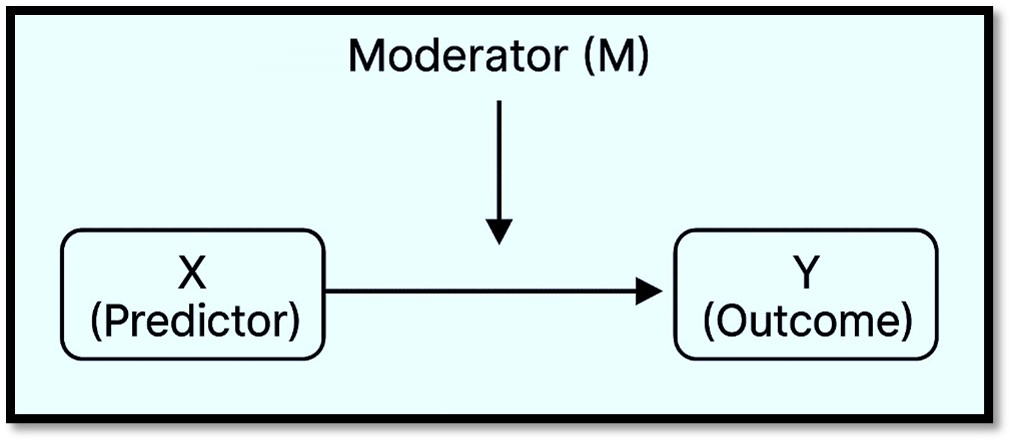
A moderator is a variable that changes the strength or direction of the relationship between an independent variable (X) and a dependent variable (Y).
Mathematically, moderation is represented by an interaction effect:
Y = b0 + b1X + b2M + b3(X×M) + ε
Where:
X = Predictor
M = Moderator
X × M = Interaction term
b₃ = Shows whether moderation exists
If the interaction term is significant → Moderation exists.
Conceptual Diagram of Moderation
Example: Moderation in Psychology
In psychological research, moderation is frequently used to understand individual differences. A common example involves examining whether emotional intelligence alters the effect of workplace stress on job performance. Employees with high emotional intelligence often manage stress more effectively and maintain better performance under pressure, whereas those with lower emotional intelligence may experience sharper performance drops when stress levels rise. This type of moderation helps organisations identify the kinds of competencies that protect employees from adverse work conditions.
Example:
Does Emotional Intelligence (Moderator) change the effect of Workplace Stress (X) on Job Performance (Y)?
- High EI employees may handle stress better.
- Low EI employees may show performance decline under stress.
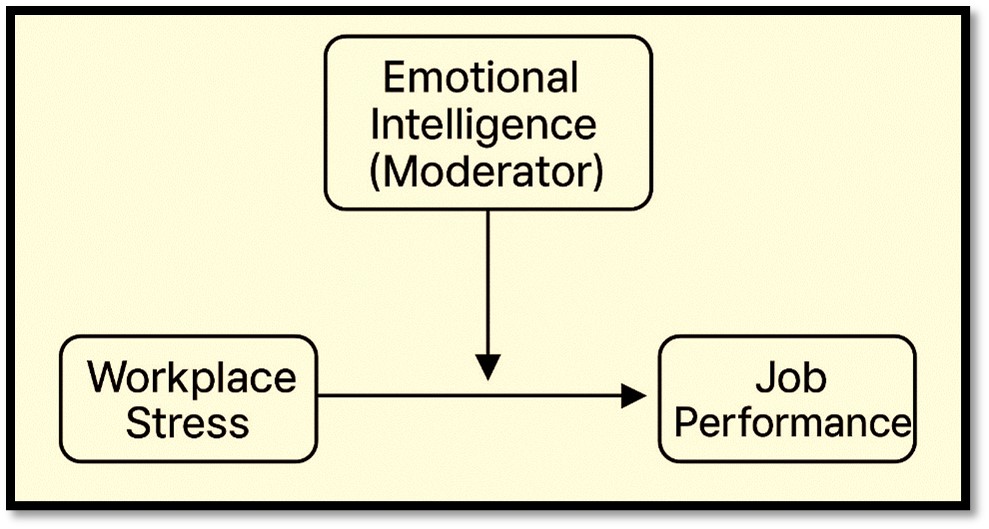
Predictor (X): Workplace Stress (Independent Variable)
Moderator (M): Emotional Intelligence
Outcome (Y): Job Performance (Dependent Variable)
Practical Examples from different domains of study
1. Moderation in Marketing and Consumer Behaviour
Consumer behaviour researchers often explore whether demographic or psychological factors change how consumers respond to marketing stimuli. For instance, the impact of AI-driven product recommendations on online purchase intention may differ across age groups. Younger consumers, who are more accustomed to digital environments, may respond strongly to personalised AI suggestions, while older consumers may rely more on traditional cues such as customer reviews. This indicates that age moderates the influence of AI recommendation quality on purchase decisions, leading marketers to tailor strategies to specific demographic segments.
Predictor (X): Quality of AI-driven product recommendations
Moderator (M): Age group of consumers (e.g., younger vs. older consumers)
Outcome (Y): Online purchase intention
2. Moderation in Education
Educational researchers use moderation analysis to understand the varied effects of academic inputs across student groups. One common application involves studying whether parental support influences the relationship between study hours and academic achievement. When parental support is strong, students may achieve better outcomes even with moderate study hours, as the supportive environment enhances learning efficiency. In contrast, students with limited parental support may benefit less from the same number of study hours, making the relationship between time spent studying and academic performance much more dependent on external guidance.
Predictor (X): Study hours
Moderator (M): Parental support
Outcome (Y): Academic achievement
3. Moderation in Health Sciences
Moderation analysis also plays an important role in health research, particularly in understanding behavioural and lifestyle influences. For example, the relationship between diet quality and BMI may vary depending on a person’s physical activity level. Individuals with high activity levels may maintain healthier BMI values even with inconsistent diets, while those with low activity levels may experience stronger weight fluctuations in response to dietary changes. In this scenario, physical activity moderates the effect of diet on BMI, helping researchers and practitioners design more personalised health interventions.
Predictor (X): Diet quality
Moderator (M): Physical activity level
Outcome (Y): Body Mass Index (BMI)
4. Moderation in Social Sciences
In social science research, moderation is used to understand how social or contextual factors shape behavioural outcomes. An illustrative example involves examining whether social support moderates the link between financial strain and mental well-being. For individuals experiencing high financial pressure, strong social support can lessen the negative impact on mental health, whereas low social support may heighten vulnerability to stress. This understanding helps policymakers and counsellors develop targeted programs aimed at populations that lack protective social networks.
Predictor (X): Financial strain
Moderator (M): Social support
Outcome (Y): Mental well-being
5. Moderation in HR
Consider a workplace example in which an organisation wants to understand whether the internal climate changes the effect of leadership effectiveness on employee productivity. In supportive organisational climates, strong leadership may result in significantly higher productivity, whereas in rigid or toxic climates, the effect of leadership might be diminished. This demonstrates how a moderator reshapes the primary relationship and provides insights that go beyond simple linear associations.
Predictor (X): Leadership effectiveness
Moderator (M): Organisational climate (supportive vs. rigid/toxic)
Outcome (Y): Employee productivity
Table: Examples of Moderation Across Six Domains
| Domain / Example | Predictor (X) | Moderator (M) | Outcome (Y) |
| Marketing & Consumer Behaviour | AI Recommendation Quality | Age Group | Online Purchase Intention |
| Education | Study hours | Parental Support | Academic Achievement |
| Health Sciences | Diet Quality | Physical Activity level | Body Mass Index (BMI) |
| Social Sciences | Financial Strain | Social Support | Mental Well-being |
| Psychology | Workplace Stress | Emotional Intelligence | Job Performance |
| Human Resources | Leadership Effectiveness | Organisational climate | Employee Productivity |
When to Use Moderation Analysis
Moderation analysis is particularly useful when researchers believe that an effect is not uniform across all respondents or circumstances. It is appropriate when theory or past studies suggest that a relationship changes strength or direction depending on another variable. Moderation can help identify subgroups that experience stronger, weaker, or opposite effects, enabling more accurate interpretation and more effective decision-making.
Statistical Tools used for Moderation Analysis
Moderation analysis can be performed using several statistical tools that simplify the detection and interpretation of interaction effects. One of the most widely used tools is the PROCESS Macro developed by Andrew Hayes, which runs within SPSS, SAS, and R. PROCESS Model 1 is specifically designed for moderation and automatically computes interaction effects, conditional effects at different levels of the moderator, and simple slope analysis. It produces user-friendly output that researchers can interpret without needing to manually compute interaction terms or complex model equations. Tools like SPSS also allow researchers to create interaction terms manually using the “Compute Variable” function, followed by regression analysis, but PROCESS provides a more streamlined and error-free workflow.
Advanced statistical environments like R and Structural Equation Modelling (SEM) platforms, including AMOS, SmartPLS, and Mplus, offer greater flexibility for modelling moderation in complex datasets. SEM tools can incorporate latent constructs as moderators, making them suitable for psychological, organisational, and behavioural research where variables are not directly observable. These tools not only test moderation but also help generate plots, conditional effect tables, and model-fit indices, enabling researchers to draw richer, theoretically meaningful interpretations from their data.
Moderation Analysis when Moderator is Categorical Variable
When the moderator is categorical, the approach to moderation analysis becomes slightly different because the moderator represents distinct groups rather than a continuous range of values. In this case, moderation is examined by testing whether the effect of the predictor (X) on the outcome (Y) differs across groups—for example, gender (male vs. female), age groups (Gen-Z vs. Gen-X), customer segments (high-income vs. low-income), or treatment groups (control vs. intervention). The categorical moderator is typically dummy-coded (e.g., 0 and 1) before creating the interaction term. Once coded, the analysis proceeds by including the predictor, the moderator, and the interaction term in a regression model. A significant interaction indicates that the relationship between X and Y is meaningfully different across the categorical groups.
Tools like SPSS, PROCESS Macro, R, and SEM platforms handle categorical moderation effectively through dummy coding or multi-group analysis. PROCESS Macro automatically manages dummy coding and produces separate conditional effects for each category. In SEM-based approaches, researchers often use multi-group SEM, where the model is estimated separately for each group and then compared to test whether relationships differ across categories. This approach is especially useful when the moderator has more than two categories or when theoretical models involve latent constructs. Ultimately, categorical moderation helps researchers understand whether effects vary meaningfully across well-defined segments, supporting more targeted interpretations, interventions, and strategies.
Conclusion
Moderation analysis is a powerful method for identifying conditional relationships and understanding how contextual, personal, or environmental factors influence research outcomes. Whether examining stress responses in psychology, consumer reactions in marketing, academic achievement in education, health outcomes in medical research, or social behaviour in community studies, moderation provides a richer and more accurate understanding of how variables interact. By recognising that effects differ across people and situations, moderation analysis helps researchers draw more meaningful conclusions and design better-targeted interventions.






Leave a Reply